
Why Is My French Press Coffee Weak?
Why Is My French Press Coffee Weak? 10 Causes and 6 Practical Fixes
If your French press coffee tastes weak, start by checking how much coffee you used, how coarse you ground it, and whether the water was hot enough. Too little coffee relative to water produces a thin cup; insufficient extraction can make it taste hollow, sour, or grassy. These problems can occur together, but they require different adjustments.
You do not need to buy a new French press to improve your coffee. A scale, a repeatable recipe, and a few controlled changes can make a noticeable difference.
Quick Diagnosis: Why Your French Press Tastes Weak
| What you notice | Likely issue | What to try next |
|---|---|---|
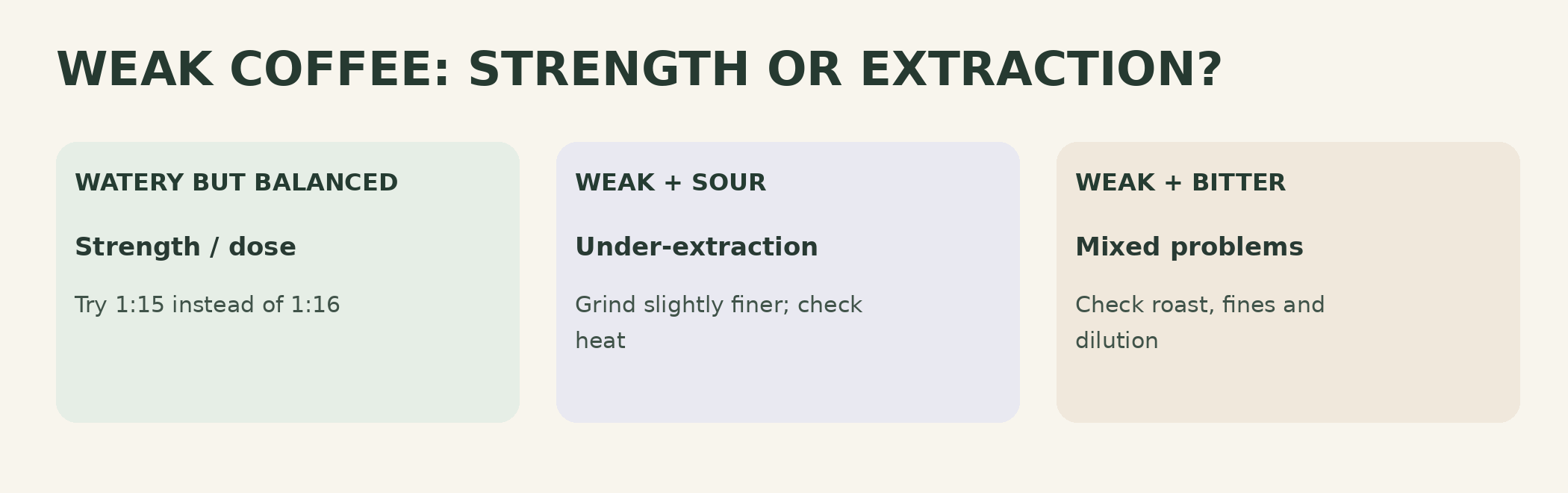
| Watery but otherwise balanced | Too little coffee for the water | Increase the dose; try 1:15 instead of 1:17 |
| Thin, sharp, or sour | Insufficient extraction | Grind slightly finer or allow more contact time |
| Weak despite a generous dose | Very coarse or inconsistent grind | Use a more uniform medium-coarse grind |
| Flat, especially in a small batch | Water or brewer loses heat quickly | Preheat the press and check brewing temperature |
| Uneven cup, dry grounds floating on top | Incomplete wetting | Wet all grounds and break the crust gently |
| Weak after adding milk or ice | Dilution after brewing | Brew a more concentrated base |
These are diagnostic starting points, not guarantees. Change one variable at a time so you can identify what actually helps.
First, Understand What “Weak” Coffee Means
People use the word weak for two different sensory experiences: low beverage strength and low extraction. Strength describes how concentrated the dissolved coffee is in the cup; extraction describes how much soluble material was removed from the grounds. A cup can be strong but sour, or relatively light yet balanced.
Weak and Watery vs Weak and Sour
If the coffee is smooth but tastes diluted, increasing the coffee dose is often the simplest correction. If it tastes sour, grassy, or hollow, the problem may be insufficient extraction: hotter water, a modestly finer grind, better wetting, or more time may help. If it tastes bitter and harsh instead, avoid automatically making all those changes at once.
For a repeatable starting method, consult how to brew French press coffee. If the issue is mainly how much coffee to use, focus on the French press coffee ratio.
10 Reasons Your French Press Coffee Tastes Weak
1. You Are Using Too Little Ground Coffee
A common cause of watery French press coffee is a low dose. Scoops are imprecise because beans and grounds vary in density. Weigh both coffee and water instead. A practical starting point is 30 g coffee with 480 g water (1:16). If that tastes too light but otherwise balanced, try 32 g with the same 480 g water (1:15).
There is no universal ideal ratio for every roast or palate. Treat the French press coffee ratio as a dial you can adjust, not a fixed rule.
2. Your Grind Is Too Coarse
Extremely large coffee particles extract slowly. A grind resembling large gravel can leave your cup hollow even after several minutes. Try a uniform coarse-to-medium-coarse setting, then move one small step finer if needed. Avoid making the grind powdery: too many fines can increase sediment and muddy flavors.
The exact grinder setting varies by burr design, so visual descriptions are only approximations. See French press grind size for more precise troubleshooting.
3. You Are Steeping for Too Little Time
Four minutes is a familiar French press benchmark, not a universal finishing line. If your coffee is underdeveloped at four minutes, test five minutes using the same dose, water, and grind. Some immersion recipes benefit from longer resting and settling periods. Extraction slows as the water cools and approaches equilibrium, so a longer steep does not necessarily make coffee intensely bitter.
4. Your Water Is Too Cool
Cool water extracts more slowly. As a starting point, try water around 93–96°C (200–205°F) for a typical medium roast, adjusting for taste and roast level. A dark roast may taste better with slightly cooler water, while a light roast may benefit from higher temperatures. Preheating a glass or metal press helps reduce heat loss.
5. The Grounds Are Not Fully Saturated
When dry grounds float in a thick crust, some particles may not interact with water evenly. Pour carefully to wet all grounds, then stir gently once or break the crust after the initial steep. Avoid vigorous repeated stirring, which can suspend fine particles and change the cup’s texture.
6. You Are Using an Inconsistent Grinder
A blade grinder may produce both powder and large chunks in the same batch. The chunks can remain under-extracted while the fines contribute sediment and bitterness. A burr grinder makes it easier to repeat a good result, but you can still improve consistency by measuring and keeping your grinding routine stable.
7. Your Coffee Beans Are Stale or Have a Mild Flavor Profile
Old coffee can lose aroma and taste flat even when brewed correctly. Check roast date when available, store beans sealed away from heat and moisture, and grind close to brewing. Also consider the beans themselves: a delicate light roast can taste less heavy-bodied than a darker roast without being poorly brewed. Do not confuse a preferred flavor profile with a brewing defect.
8. You Are Brewing a Very Small Batch in a Large Press
A small batch in a large, cold brewer may lose heat faster. A poorly matched plunger or unusually shallow coffee bed can also make the process less convenient. Use an appropriately sized brewer when possible, preheat it, and measure the actual water added rather than relying on capacity markings.
9. You Dilute the Coffee After Brewing
Milk, cream, melting ice, or added hot water lowers the concentration of coffee in the final drink. If you routinely add milk, test a somewhat stronger brewing ratio, such as 1:14–1:15, while checking that the flavor stays balanced. Stronger coffee does not automatically mean better-extracted coffee.
10. You Are Judging Strength by Sediment or Color Alone
French press coffee often has more oils and suspended particles than paper-filtered coffee, but sediment is not a reliable measurement of beverage strength. Likewise, dark color is affected by roast and lighting. Taste for sweetness, acidity, body, and balance; compare measured recipes side by side instead of relying on appearance.
How to Fix Weak French Press Coffee: A Repeatable Recipe
Six-Step Brewing Process at a Glance
Use this visual checklist before the detailed steps. Make one change at a time to identify what improves your cup.
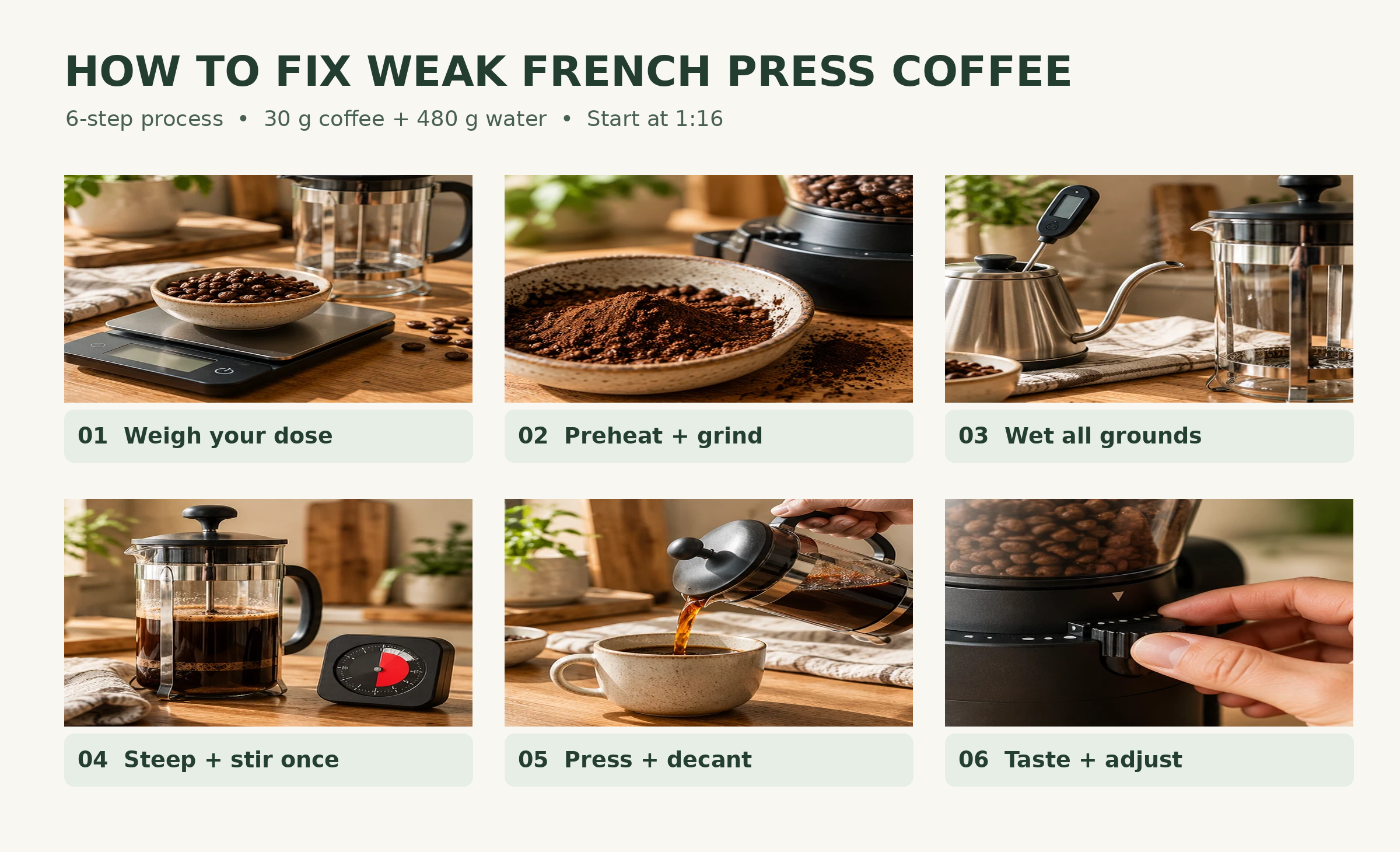
This is a starting recipe for diagnosis, not a claim that every coffee tastes best with these settings.
| Variable | Starting setting |
|---|---|
| Coffee | 30 g freshly ground coffee |
| Water | 480 g |
| Ratio | 1:16, coffee to water by weight |
| Grind | Uniform medium-coarse |
| Water temperature | 93–96°C / 200–205°F |
| Initial steep | 4–5 minutes |
| Finish | Break crust gently, allow grounds to settle, plunge slowly if desired, and decant |
Step 1: Weigh Coffee and Water
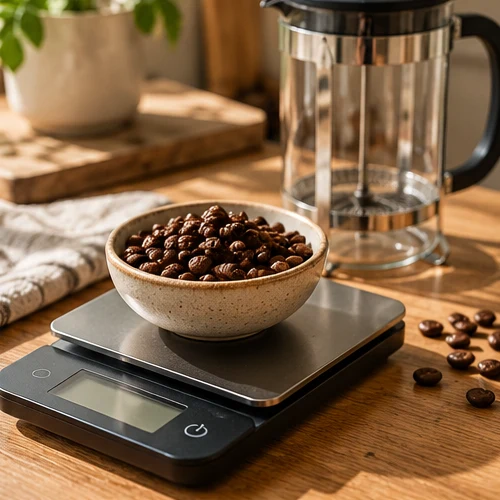
Measure 30 g coffee and 480 g water. This removes the guesswork associated with tablespoons and volume markings.
Step 2: Preheat and Grind
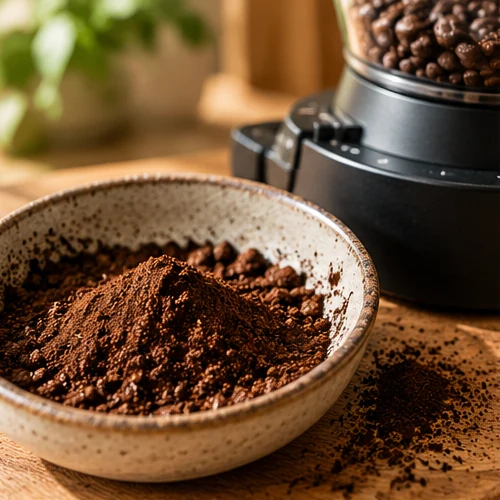
Warm the press with hot water, discard that water, then add the freshly ground coffee. Begin with a medium-coarse grind rather than extremely coarse chunks.
Step 3: Add Hot Water and Wet Every Ground
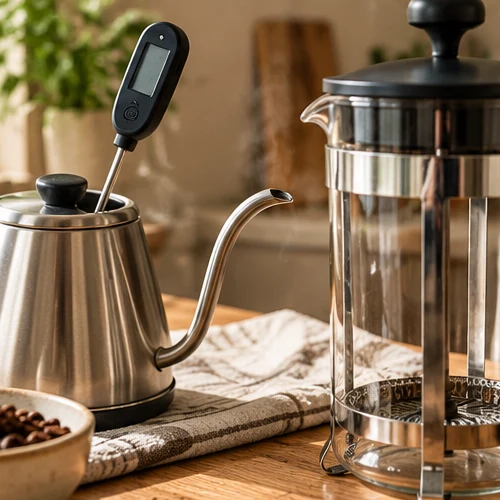
Pour all 480 g of water, ensuring the coffee is saturated. A brief gentle stir is enough if you notice dry clumps.
Step 4: Steep and Break the Crust
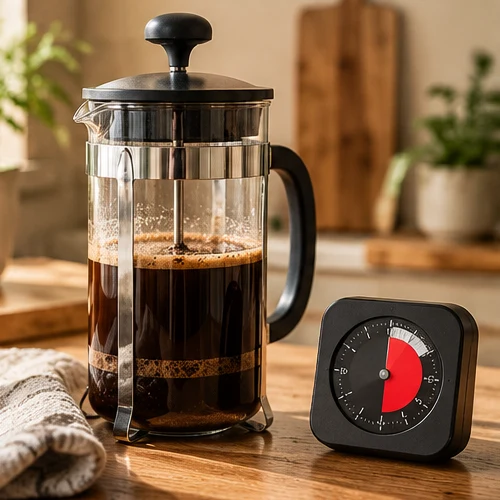
Start a timer and let the coffee steep for about four to five minutes. Gently break the surface crust. If desired, wait another minute or two for suspended grounds to settle; keep this routine consistent during your tests.
Step 5: Press Gently and Pour
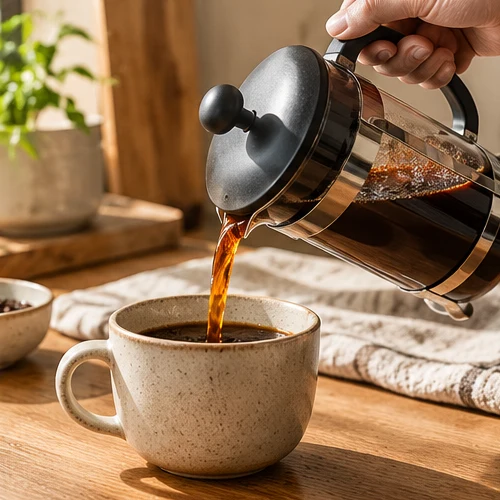
Lower the plunger slowly without forcing it, or use it as a surface strainer after the grounds settle. Pour the brewed coffee into cups or a separate carafe. This keeps the serving process consistent and avoids leaving the remaining beverage on the grounds for an extended period.
Step 6: Taste Before Changing Anything
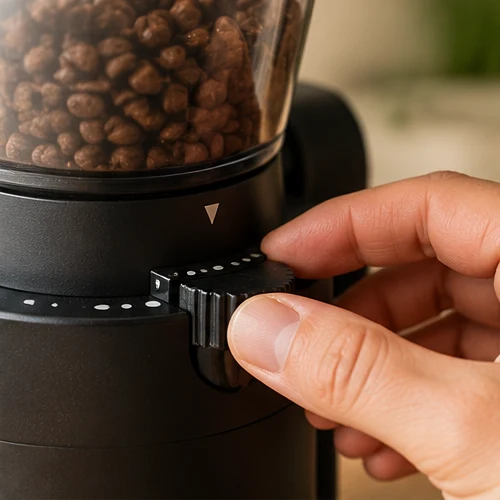
If it tastes watery but balanced, increase the dose next time. If it is sour or hollow, first try a slightly finer grind or a longer steep. Record your result so each adjustment teaches you something.
French Press Strength: Coffee-to-Water Ratio Chart
The chart below keeps water at 480 g so you can see how changing the coffee dose affects the brewing ratio.
| Target ratio | Coffee | Water | Practical use |
|---|---|---|---|
| 1:18 | 26.7 g | 480 g | Lighter starting point |
| 1:17 | 28.2 g | 480 g | Milder starting point |
| 1:16 | 30 g | 480 g | Balanced baseline |
| 1:15 | 32 g | 480 g | Stronger starting point |
| 1:14 | 34.3 g | 480 g | Concentrated starting point |
Ratios describe dry coffee mass divided by brewing water mass, not the final liquid yield. Some water stays trapped in the grounds. “Stronger” here means a higher dose at the same water quantity; the perceived result still depends on extraction and beans.
A Simple Three-Batch Troubleshooting Experiment
| Batch | What changes? | What it tells you |
|---|---|---|
| A — Baseline | 30 g coffee, 480 g water, standard grind | Establishes your reference cup |
| B — Dose test | 32 g coffee, 480 g water, same grind and time | Tests whether more concentration helps |
| C — Extraction test | Return to 30 g and 480 g; grind one small step finer | Tests whether extraction needs improvement |
Use the same beans, brewer, water temperature, and steeping routine in all three batches. Taste them at a similar drinking temperature. Do not change dose and grind simultaneously or you will not know which change mattered.
Final Verdict: How to Make French Press Coffee Less Weak
Start by measuring 30 g coffee to 480 g water, using a consistent medium-coarse grind, brewing with adequately hot water, and steeping for roughly four to five minutes. If the result is watery but balanced, increase the coffee dose. If it is sour or hollow, improve extraction with a modestly finer grind or a longer steep. Keep each test controlled and record what tastes better.
Once you can distinguish low strength from under-extraction, weak French press coffee becomes a solvable brewing problem rather than a mystery.
For more focused brewing guidance, see French Press Coffee Ratio, French Press Grind Size, How to Make French Press Coffee, and Why Is My French Press Coffee Bitter?. These are editorial internal-link placeholders, not active links.
Editorial note: Brewing suggestions are starting points, not results from a controlled tasting trial. Images are illustrative AI-generated visuals. Follow your coffee maker’s safety and care instructions.
Sources and Further Reading
- Barista Hustle — If and When to Stir a French Press
- Barista Hustle — Profiling Temperature and Time
- Specialty Coffee Map — French Press Brewing Guide
Frequently Asked Questions
Why is my French press coffee watery?
Too little coffee relative to water is a frequent reason. Weigh your ingredients and try a ratio around 1:16, then adjust toward 1:15 if you prefer a fuller cup.
Does grinding finer make French press coffee stronger?
A finer grind can increase extraction and sometimes the concentration of dissolved solids, but it also changes flavor and may add sediment. If the cup is already balanced but light, increasing the dose is a more direct adjustment.
Is four minutes enough for French press coffee?
Four minutes can work, but it is not mandatory. Depending on grind size, roast, temperature, and agitation, five minutes or longer may give a more developed cup.
What is the best French press ratio for strong coffee?
Try 1:15 as a stronger starting point, such as 32 g coffee with 480 g water. A 1:14 ratio is more concentrated still, but balance and personal preference matter.
Can water temperature make French press coffee weak?
Yes. Water that is too cool can slow extraction, particularly with light roasts or coarse grounds. Try water around 93–96°C (200–205°F) as a starting range and adjust by taste.
Why does my French press taste weak even with more coffee?
Check grind size, water temperature, steep time, freshness, and complete wetting. More grounds can increase concentration without correcting a sour or hollow flavor.
Does pressing the plunger harder make stronger coffee?
No. The plunger primarily separates grounds from the beverage. Forcing it can stir up sediment and does not reliably improve extraction.
Should I stir French press coffee?
A gentle stir or crust break can help ensure even wetting and more repeatable results. Avoid vigorous, repeated agitation unless it is part of a controlled recipe.
Can stale beans make French press coffee taste weak?
Yes. Beans that have lost aroma can taste flat even at an appropriate ratio. Store beans properly and use fresh grounds when possible.
Why is French press coffee weaker after adding milk?
Milk dilutes the coffee and changes how its flavors are perceived. If you usually add milk, brew a slightly more concentrated cup and adjust to taste.

Hi, I’m Sophie Laurent, a passionate coffee enthusiast and lifestyle writer with a special interest in coffee brewing, specialty coffee, coffee beans, French café culture, and professional coffee preparation techniques. I enjoy exploring the fascinating world of coffee, from espresso, cappuccino, and latte to French press, pour-over, cold brew, and traditional French coffee, with a focus on understanding their unique flavors, aromas, brewing methods, and characteristics.
When I’m not researching the latest coffee trends and brewing traditions, I’m exploring coffee bean varieties, roasting profiles, grind sizes, brewing ratios, extraction methods, coffee equipment, and techniques for making better coffee at home. My goal is to make coffee-related topics easy to understand by providing honest, practical, and well-researched information that helps readers choose the right coffee beans, improve their brewing techniques, compare different coffee methods, and discover flavors that match their personal preferences.
I write for Cafe-Marie-Jeanne.com, where I share detailed brewing guides, helpful comparisons, and practical advice about coffee, with a particular focus on coffee quality, brewing methods, coffee beans, grind size, coffee-to-water ratios, extraction, brewing equipment, flavor profiles, and French coffee traditions. My mission is to help readers make informed decisions, develop their coffee knowledge, master everyday brewing techniques, and enjoy delicious, café-quality coffee at home with confidence.