
French Press Grind Size: The Best Grind for Perfect Coffee
Coffee & Brewing · Café Marie Jeanne
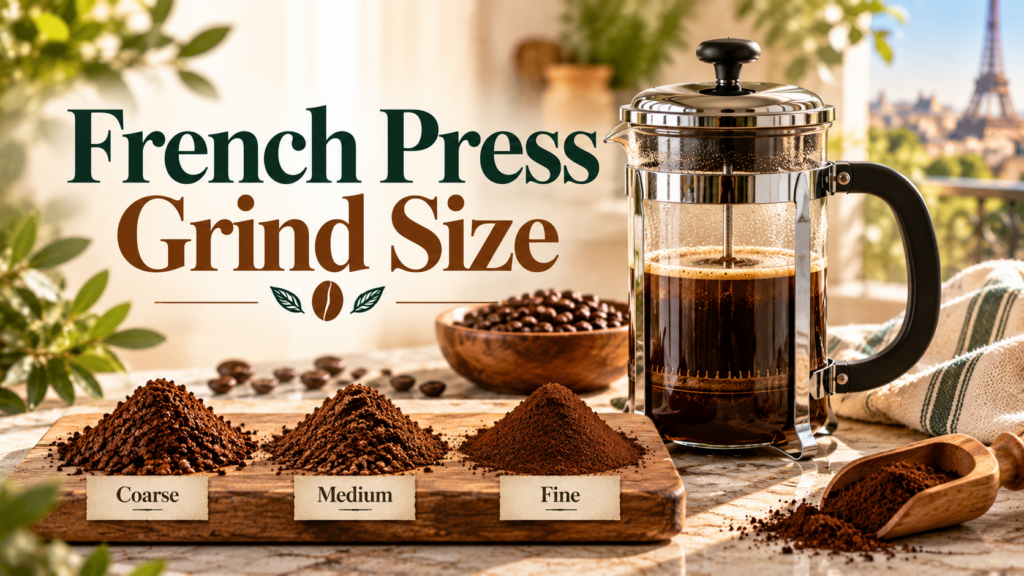
French press grind size should usually start at medium-coarse to coarse: visible, fairly even particles resembling coarse sea salt or raw sugar, not fine sand. There is no universal grinder number. Use the texture as your first reference, then adjust according to taste, sediment, and how easily the plunger moves.
French Press Grind Size Chart: Fine vs Medium-Coarse vs Coarse
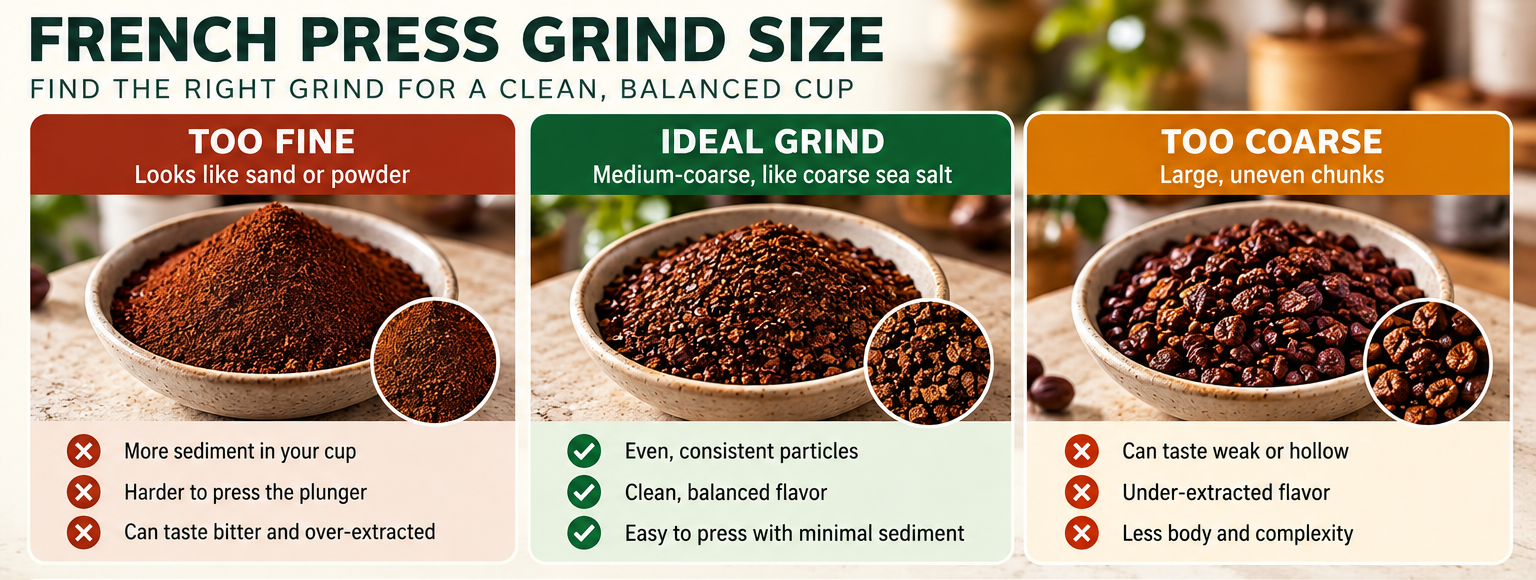
The visual differences matter more than an arbitrary number on the grinder dial. Fine particles extract faster and pass more readily through a metal mesh; exceptionally large chunks can extract slowly and taste underdeveloped. A uniform grind helps you repeat a recipe.
What Should French Press Coffee Grounds Look Like?
Think of coarse sea salt or raw sugar crystals: distinct granules with some natural variation. Avoid two extremes: powdery grounds resembling espresso or very large, irregular chunks resembling broken peppercorns. A grinder that produces both extremes in one batch makes consistent results harder.
Is Medium-Coarse Better Than Very Coarse?
Often, yes. Traditional French press advice favors coarse grounds, but a consistent medium-coarse grind may give a sweeter, more complete extraction with a four-minute steep. Very coarse grounds are not automatically better. The ideal texture depends on your beans, grinder, water temperature, agitation, and preferred cup.
French Press Grind Size Comparison Table
| Grind | What it looks like | Possible result | Best next action |
|---|---|---|---|
| Fine | Powder, fine sand | More silt, greater plunge resistance | Move coarser |
| Medium | Granulated sugar | Can work with controlled technique; more fines may appear | Judge cup clarity and taste |
| Medium-coarse | Raw sugar, smaller sea-salt crystals | Balanced starting region | Start here and record results |
| Coarse | Coarse sea salt | Cleaner texture; may need time or heat adjustments | Try if cup is muddy |
| Extra-coarse | Large uneven chunks | May taste thin or hollow | Try one step finer |
Texture descriptions are approximate. They are not laboratory particle-size specifications, and individual burr grinders create different distributions.
French Press Grind Size Process Chart: From Grinder to Cup
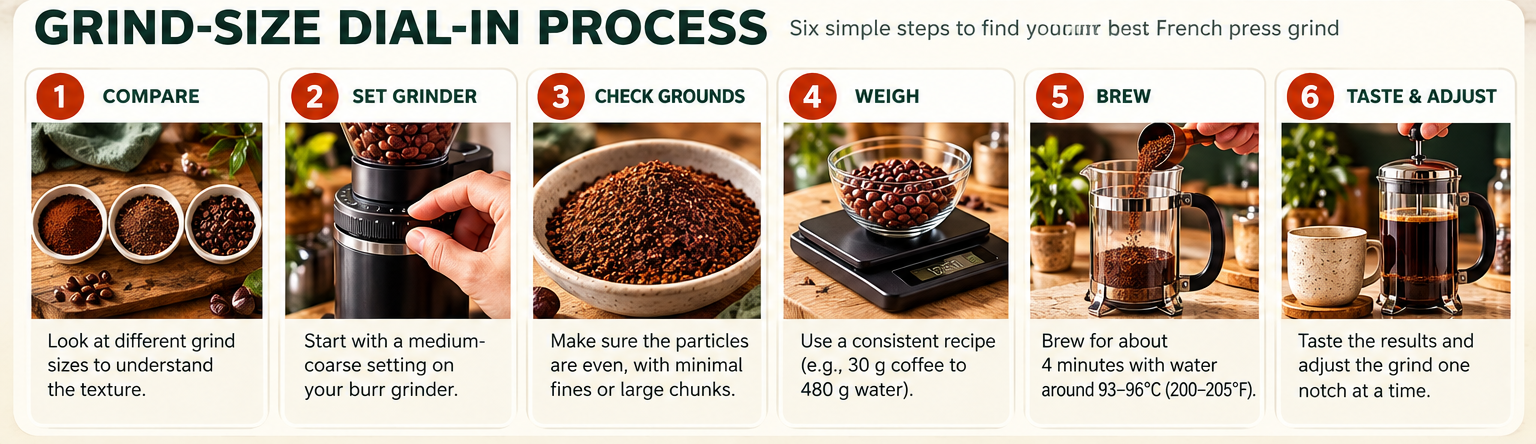
How to Dial In French Press Grind Size: Step by Step
Use this six-step test to find a repeatable setting. This is a grind-calibration workflow, not a replacement for the full how to make French press coffee brewing guide.
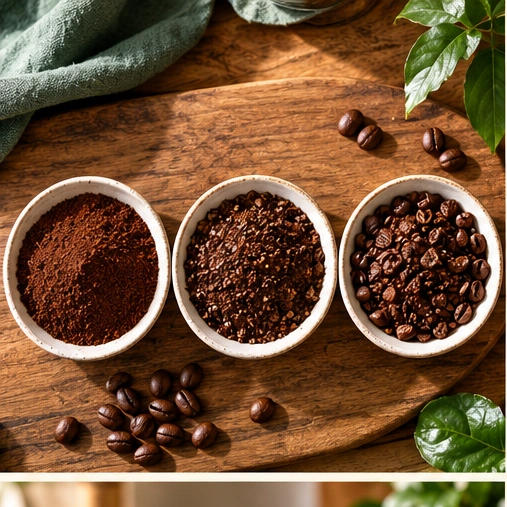
Step 1: Compare the three grind textures
Look at fine, medium-coarse, and very coarse particles side by side. Begin with clearly visible granules, similar to coarse sea salt rather than flour.
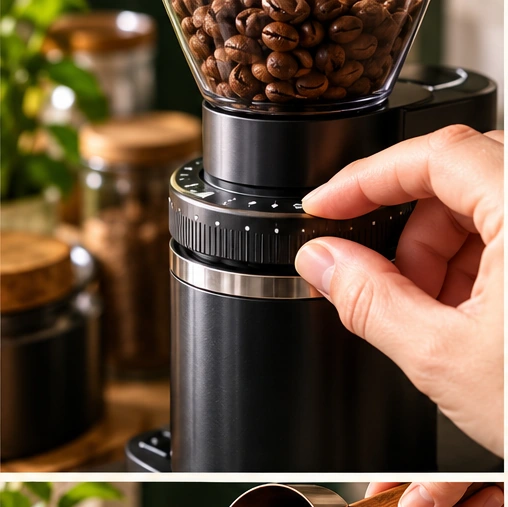
Step 2: Set your burr grinder to medium-coarse
Choose the middle of your grinder’s recommended French press range, then record the actual setting. Number scales are not standardized across grinders.
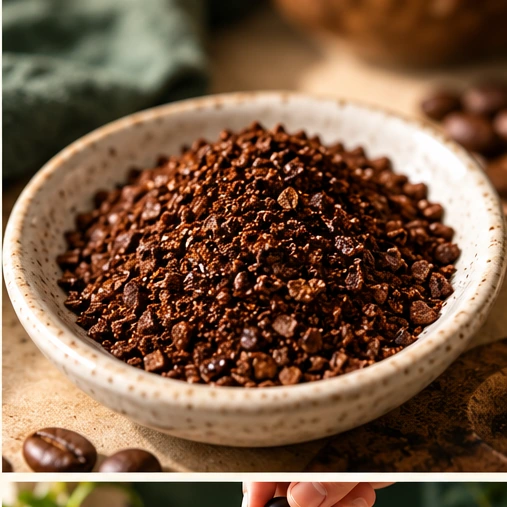
Step 3: Inspect the freshly ground coffee
Check a spoonful for reasonably even pieces. A little fine dust is normal, but large amounts of powder mixed with boulders indicate an uneven grind.
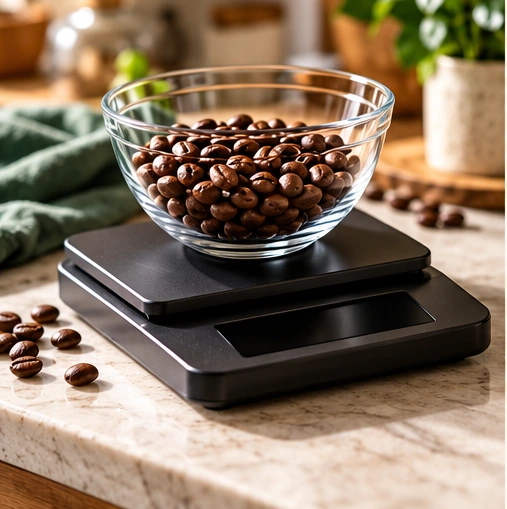
Step 4: Weigh a repeatable dose
Use a scale to measure 30 g of beans or grounds. Keep your dose fixed while testing grind size, so you can tell which change improved the cup.
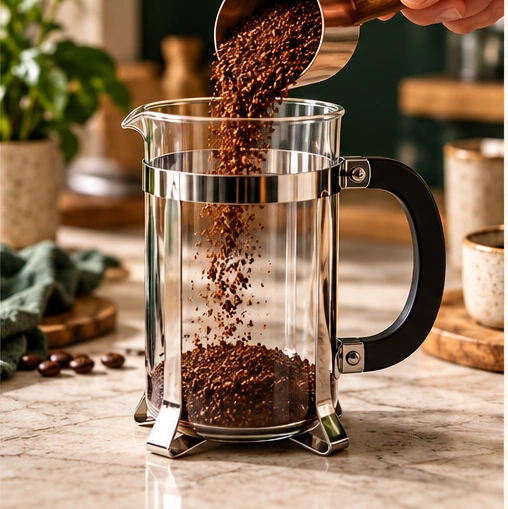
Step 5: Brew with a fixed recipe
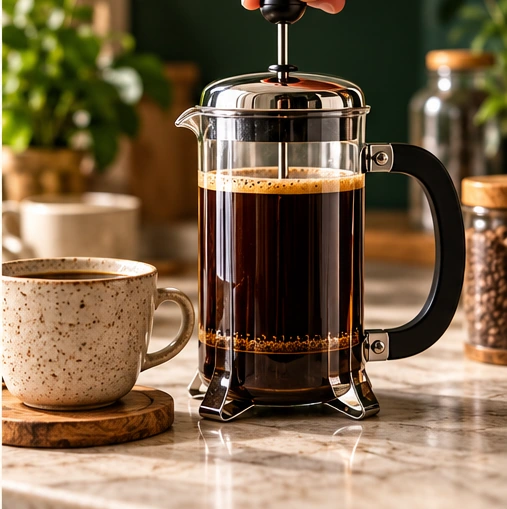
Add 30 g grounds to a French press, pour in 480 g hot water (about 93–96°C / 200–205°F), wet all grounds, and steep about four minutes. Plunge gently and decant.
Step 6: Taste, then adjust one setting
If the cup is hollow or sour, move slightly finer. If it is silty, harsh, or difficult to plunge, try slightly coarser. Repeat without changing dose and time.
Grind Size Troubleshooting: What Your Cup Is Telling You
| Symptom | Possible explanation | First test |
|---|---|---|
| Thin, hollow, sour | Grind may be too coarse or extraction too low | One small step finer |
| Very muddy or silty | Excess fines, stirring, or mesh issue | Grind more evenly; plunge gently |
| Hard to push plunger | Fine grounds clogging the filter | Move coarser; never force the plunger |
| Bitter or drying | Roast, extraction, fines, or prolonged contact | Test slightly coarser while holding other variables |
| Weak but balanced | Low concentration, not necessarily grind | Check the French press coffee ratio |
| Results vary daily | Inconsistent grinding or measurement | Weigh ingredients and use the same routine |
French Press vs Pour-Over vs Espresso Grind Size
| Method | Typical starting grind | Why |
|---|---|---|
| French press | Medium-coarse to coarse | Immersion and metal mesh filtration |
| Pour-over | Medium to medium-fine | Grind helps control drawdown and extraction |
| Drip coffee maker | Medium | Designed for controlled filter flow |
| Espresso | Fine | Pressurized short-contact extraction |
| Cold brew | Coarse, often | Long, cool-water steeping |
Common French Press Grind Mistakes to Avoid
Do not assume “as coarse as possible” is the goal. Avoid changing grind, dose, and steep time together. Do not force a stuck plunger, and do not rely on spoon measurements when comparing batches. Finally, remember that sediment is not a direct measure of coffee strength: it mainly reflects suspended particles and filtration.
Frequently Asked Questions
What is the best grind size for French press?
Start medium-coarse to coarse, with visible, relatively even granules resembling coarse sea salt. Adjust by tasting.
Should French press coffee be coarse or medium-coarse?
Either can work. Medium-coarse is a useful starting point if extremely coarse grounds make your cup taste hollow.
Can you use fine ground coffee in a French press?
Yes, but expect more sediment and possible filter resistance. Use a gentler settling and pouring technique rather than forcing the plunger.
Is espresso grind too fine for French press?
It is generally finer than needed for a conventional French press recipe and may clog the filter or leave heavy sediment.
Why does my French press coffee taste weak?
Check dose first. If the ratio is already appropriate and the cup tastes hollow, test a slightly finer grind or longer steep.
Why is my French press coffee muddy?
A high proportion of fines, vigorous agitation, and a worn or damaged mesh can all contribute.
Does a finer grind make coffee stronger?
It can increase extraction and change perceived intensity, but coffee-to-water ratio is the more direct way to change concentration.
What Baratza Encore setting should I use?
Use your particular Encore model’s recommended French press range as a starting point; calibration and model revisions vary. Judge the grounds and cup rather than trusting one universal number.
Can I use pre-ground coffee?
Yes. Choose a grind labeled for French press if available, and adjust brew time and handling according to taste and sediment.
How long should French press coffee steep?
About four minutes is a practical starting point. Some methods use longer steeping and settling periods.
How can I reduce sediment without changing the grind?
Stir less aggressively, allow particles to settle, inspect the mesh, and decant slowly without pouring the final gritty drops.
Should I grind beans right before brewing?
Fresh grinding usually preserves more aroma and lets you control the particle size, although a good pre-ground coffee can still make a pleasant cup.
Final Takeaway
For most home brewers, the right French press grind is the one that produces a balanced cup with manageable sediment and an easy, gentle plunge. Begin medium-coarse, use a consistent recipe, and move one setting at a time. To refine the other brewing variables, see French press coffee ratio and how to make French press coffee.
Sources and Further Reading
Background reading: Moav Coffee Journal — French Press Grind Size; BrewMark — Grind Size and Brew Time; Home Coffee Beginner — Visual Grind Guide. The text, tables, and illustrations in this article were newly created for Café Marie Jeanne.

Hi, I’m Sophie Laurent, a passionate coffee enthusiast and lifestyle writer with a special interest in coffee brewing, specialty coffee, coffee beans, French café culture, and professional coffee preparation techniques. I enjoy exploring the fascinating world of coffee, from espresso, cappuccino, and latte to French press, pour-over, cold brew, and traditional French coffee, with a focus on understanding their unique flavors, aromas, brewing methods, and characteristics.
When I’m not researching the latest coffee trends and brewing traditions, I’m exploring coffee bean varieties, roasting profiles, grind sizes, brewing ratios, extraction methods, coffee equipment, and techniques for making better coffee at home. My goal is to make coffee-related topics easy to understand by providing honest, practical, and well-researched information that helps readers choose the right coffee beans, improve their brewing techniques, compare different coffee methods, and discover flavors that match their personal preferences.
I write for Cafe-Marie-Jeanne.com, where I share detailed brewing guides, helpful comparisons, and practical advice about coffee, with a particular focus on coffee quality, brewing methods, coffee beans, grind size, coffee-to-water ratios, extraction, brewing equipment, flavor profiles, and French coffee traditions. My mission is to help readers make informed decisions, develop their coffee knowledge, master everyday brewing techniques, and enjoy delicious, café-quality coffee at home with confidence.