
How to Make French Press Coffee?

How to Make French Press Coffee: 8 Easy Steps for a Better Cup
French press coffee is easy to brew when you measure the coffee and water, use an appropriate grind, and pour the finished drink away from the grounds. This guide walks through a dependable eight-step method, with photos and a printable visual checklist.
French Press Recipe at a Glance
Equipment: a French press large enough for the brew, a grinder, a digital scale, a kettle, a timer, and a mug or serving carafe. The recipe makes less than 480 g of finished coffee because the grounds retain some water.
French Press Brewing Process: Large-Text Visual Guide
Start with this full-process chart, then follow the detailed illustrated steps below. The timer starts when the hot water first reaches the grounds.
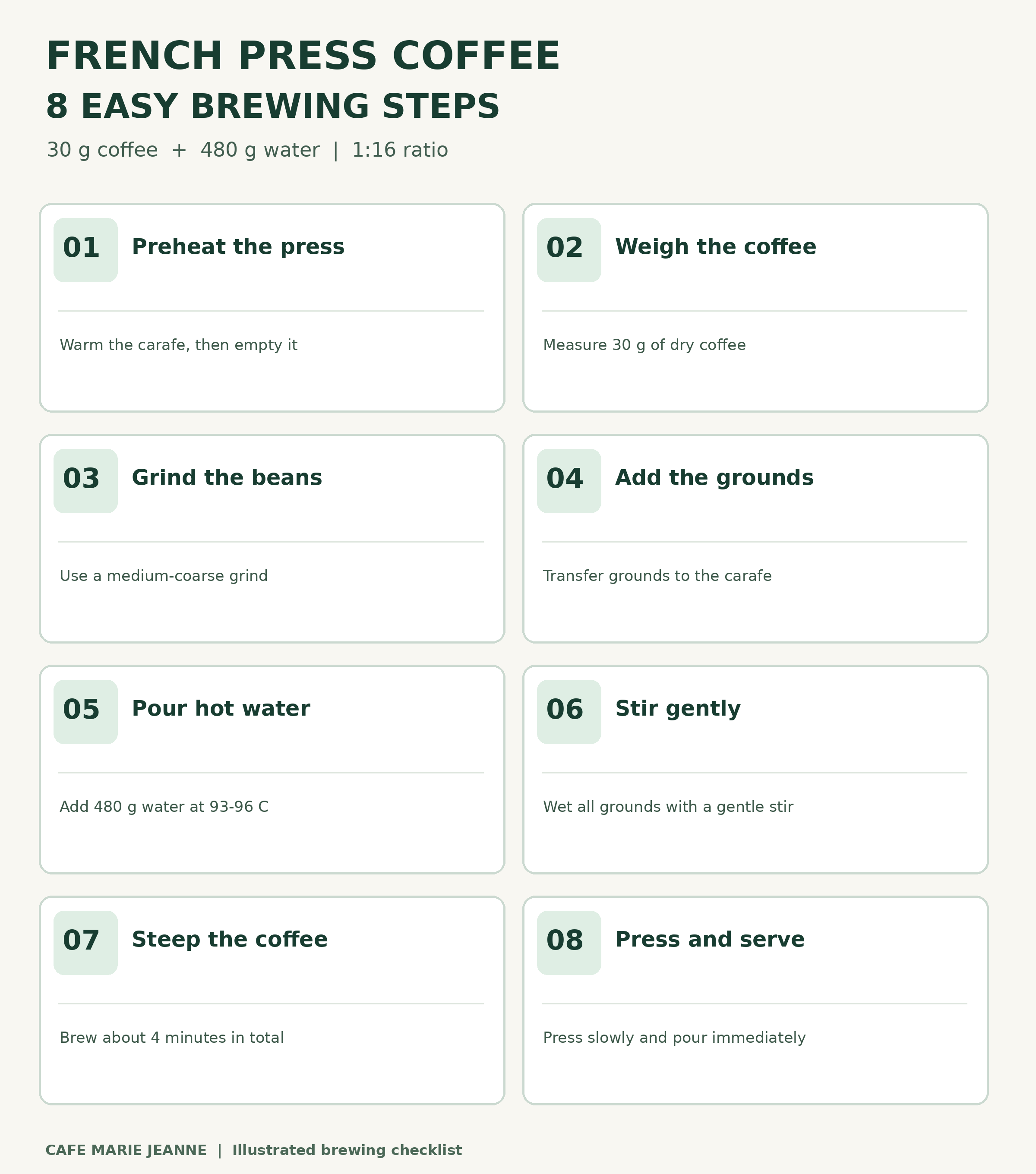
How to Make French Press Coffee: Step-by-Step
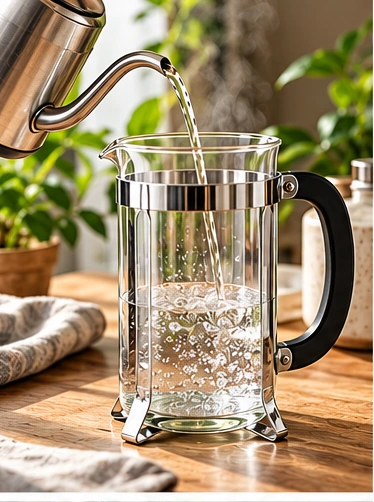
Step 1: Preheat the French press
Rinse the empty carafe with hot water for 20 to 30 seconds, then discard the rinse water. This helps limit the temperature drop when brewing begins. Handle hot glass carefully and avoid sudden temperature changes.
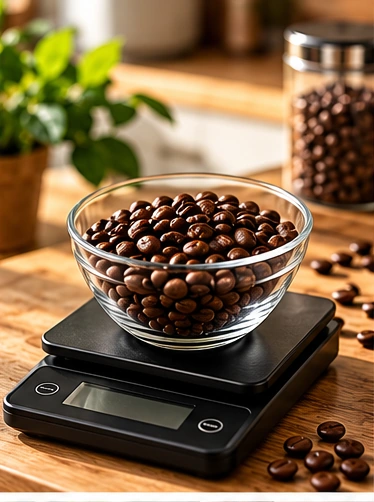
Step 2: Weigh 30 grams of coffee
Place a small container on a scale, tare it, and weigh 30 g of whole coffee beans. For a repeatable cup, weigh the water as well. A 1:16 coffee-to-water ratio means 16 g of water for every 1 g of coffee.
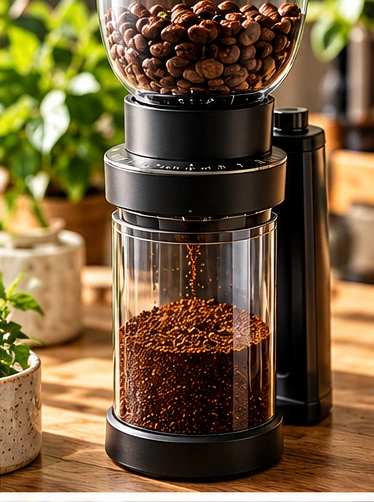
Step 3: Grind the beans medium-coarse
Use a burr grinder if available. Aim for distinct, reasonably even particles rather than powder. Grinder settings are not standardized, so adjust by taste: a hollow, sour cup may benefit from a slightly finer grind; a harsh, gritty cup may need a coarser grind.
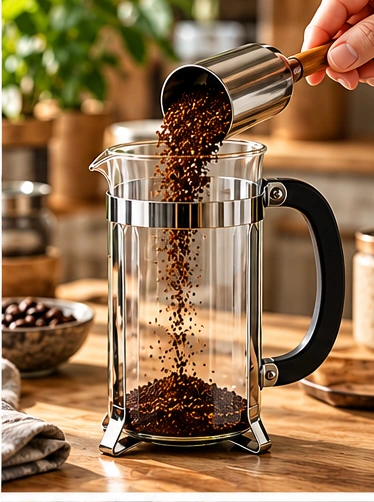
Step 4: Add the grounds to the press
Put the ground coffee into the empty, warmed carafe. Gently shake the vessel to level the bed. Avoid packing or tamping the coffee.
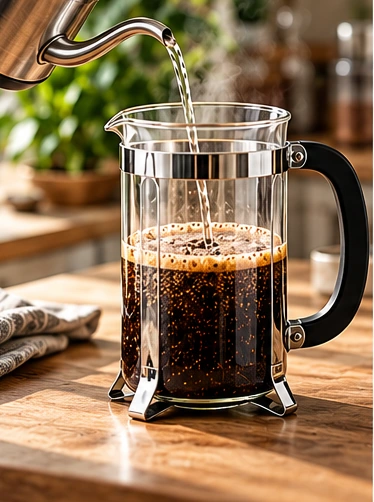
Step 5: Pour 480 grams of hot water
Heat fresh water to approximately 93°C to 96°C (199°F to 205°F). Start the timer as soon as water touches the coffee. Pour steadily until the scale reads 480 g of added water. Ensure the grounds are wetted throughout.
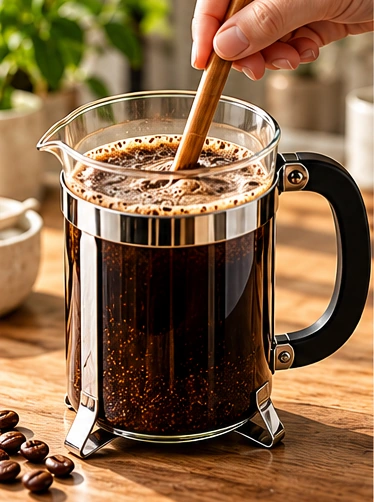
Step 6: Stir gently to wet the coffee
If a dry crust remains, give the surface a brief, gentle stir with a wooden or silicone spoon. Avoid vigorous agitation; you want all grounds in contact with water, not an unnecessarily muddy brew.
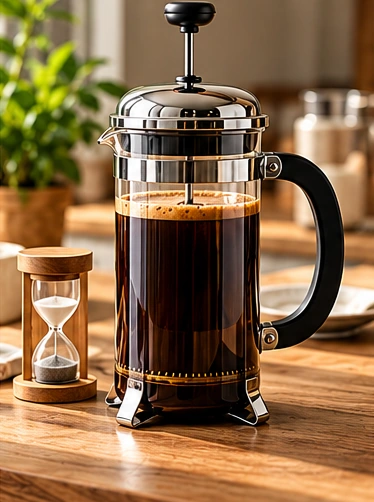
Step 7: Let the coffee steep for about four minutes
Set the lid on top without pushing the plunger down. Allow the coffee to steep until the timer reaches about 4:00 from the first pour. Four minutes is a practical starting point, not a universal rule: grind, roast, and personal preference may call for adjustment.
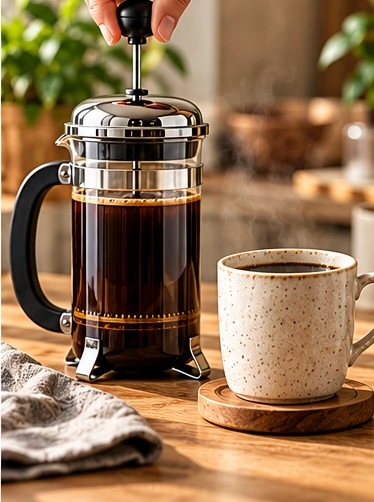
Step 8: Press slowly and decant immediately
Lower the plunger with gentle, even pressure. Do not force a stuck filter. Pour the brewed coffee into cups or a separate serving vessel so the liquid does not remain in contact with the grounds. Allow a moment for hot coffee to cool before tasting.
French Press Coffee-to-Water Ratio Chart
Ratio refers to dry coffee mass compared with added water mass. For a fixed 30 g dose, changing the amount of water changes concentration. Begin with 1:16 and adjust in small increments.
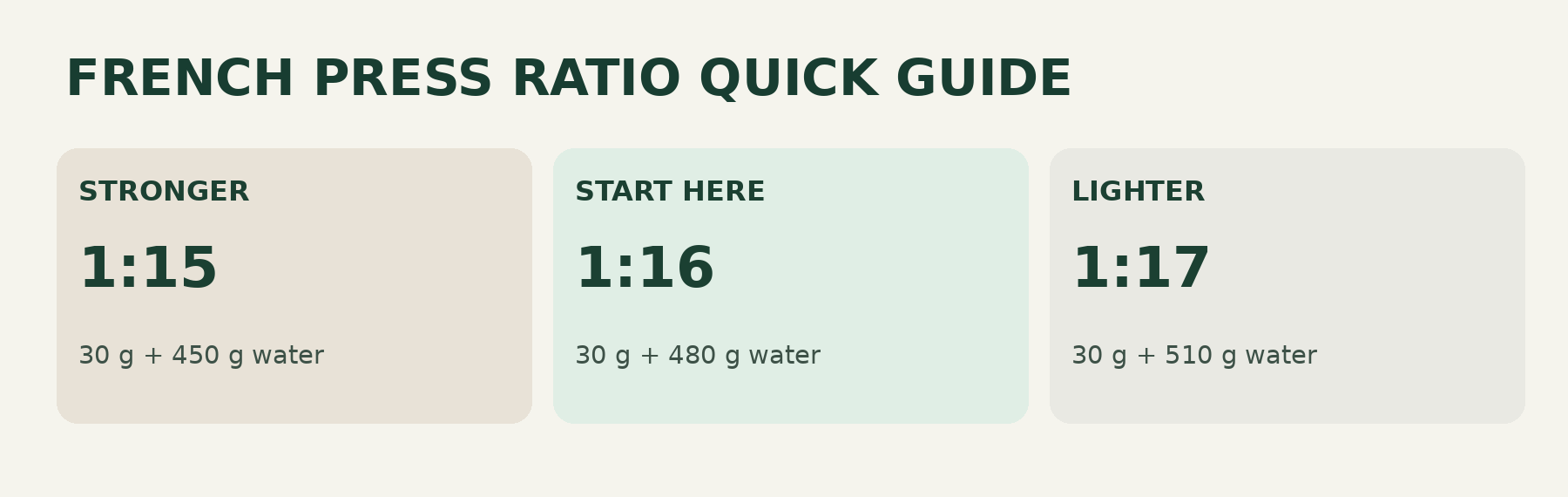
| Dry coffee | 1:15 (stronger) | 1:16 (starting point) | 1:17 (lighter) |
|---|---|---|---|
| 15 g | 225 g water | 240 g water | 255 g water |
| 20 g | 300 g | 320 g | 340 g |
| 30 g | 450 g | 480 g | 510 g |
| 40 g | 600 g | 640 g | 680 g |
For a deeper explanation of the calculations and how to scale a recipe, see French Press Coffee Ratio (internal-link placeholder).
What Grind Size Is Best for French Press?
Medium-coarse is a reliable first setting, but the best grind depends on the grinder and brewing method. Even particles make it easier to repeat results. If the coffee tastes sharp or thin, try grinding a little finer before changing several other variables. If the cup is muddy or harsh, check for excess fines and consider a slightly coarser grind. See French Press Grind Size (internal-link placeholder).
What Water Temperature Should You Use?
A practical starting range is 93-96°C (199-205 F). You do not need a laboratory-perfect number to brew well. Cooler water can make extraction slower; very hot water may accentuate harsh flavors in some coffees. Use the same temperature across successive test brews so you can judge other changes fairly.
Four Minutes vs Longer Steeping: Which Is Better?
Four minutes is a convenient beginner-friendly baseline. Some immersion methods use longer contact times followed by settling, and they can also produce excellent coffee. More time does not always mean a worse cup; grind size, agitation, roast level, and whether you decant all matter. For this straightforward recipe, taste the four-minute version first and adjust one variable at a time.
French Press vs Pour-Over vs Drip Coffee
| Method | Filter | Typical cup character | Best for |
|---|---|---|---|
| French press | Metal mesh | Fuller body, more oils and fine particles | Simple immersion brewing |
| Pour-over | Usually paper | Often clearer and lighter-bodied | Hands-on pouring control |
| Automatic drip | Usually paper | Consistent, clean cup when properly dialed in | Convenience and larger batches |
Common French Press Mistakes and How to Fix Them
| Problem | Likely contributors | First change to try |
|---|---|---|
| Weak or watery | Too much water, insufficient extraction | Verify the dose, then try a slightly finer grind |
| Sour or hollow | Insufficient extraction for this coffee | Grind a little finer or check water heat |
| Harsh or bitter | Roast character, fines, or extraction choices | Change grind or roast before changing everything |
| Muddy or gritty | Fine particles passing the mesh | Improve grind consistency; pour carefully |
| Second cup tastes harsher | Coffee left sitting on the grounds | Decant immediately after brewing |
For focused troubleshooting, see Why Is My French Press Coffee Weak? and Why Is My French Press Coffee Bitter? (internal-link placeholders).
How to Clean Your French Press After Brewing
Allow the brewer to cool enough to handle safely. Scoop the spent grounds into compost or the trash instead of washing a large quantity down the sink. Rinse the carafe, wash with mild dish soap, and clean the plunger mesh where oils collect. Rinse thoroughly and air-dry the parts. Check the manufacturer’s guidance before putting components in a dishwasher. See How to Clean a French Press (internal-link placeholder).
Final Brewing Checklist
- Weigh 30 g coffee and 480 g water.
- Use an even, medium-coarse starting grind.
- Preheat and empty the press before brewing.
- Start the timer when water touches the grounds.
- Wet all the coffee and steep about four minutes.
- Press gently and pour the coffee out promptly.
- Record changes so the next brew is easier to improve.
Sources and Editorial Notes
For further technique guidance, consult the brewing instructions published by the maker of your French press and educational resources from specialty coffee roasters. This is an independently written instructional recipe; the illustrations are AI-generated and do not document a personally conducted brew test.
Frequently Asked Questions
How much coffee do I use in a French press?
Start with a 1:16 ratio by weight, such as 30 g coffee for 480 g water. Adjust the ratio to suit your preferred strength.
How long should French press coffee steep?
About four minutes is a practical starting point for this method. Different grinds and immersion techniques may work better with other timings.
Should I use boiling water for French press coffee?
Water around 93-96°C (199-205 F) is a useful starting range. Your preferred temperature may vary by roast and flavor preference.
Should I stir French press coffee?
A brief, gentle stir can help wet dry grounds. Vigorous stirring is not necessary for this recipe.
Do I have to press the plunger all the way down?
Lower it slowly and stop if you encounter unusual resistance. Forcing a stuck plunger is unsafe and can disturb excess sediment.
Can I use pre-ground coffee?
Yes. Choose a grind suited to immersion brewing when possible, and keep the coffee sealed between uses.
Why is there sediment in my French press coffee?
Metal mesh filters let some fine coffee particles through. A more consistent grind and careful pouring can reduce sediment.
How many tablespoons of coffee equal 30 grams?
It depends on the coffee and grind. Tablespoons are less precise than a scale, so weigh the grounds when possible.
Should I leave coffee in the French press after brewing?
For this recipe, decant it into cups or a separate carafe to limit further contact with the grounds.
Is French press coffee stronger than drip coffee?
Not necessarily in caffeine concentration. Strength depends on the coffee-to-water ratio and extraction; French press often feels fuller-bodied because its mesh filter retains more oils.

Hi, I’m Sophie Laurent, a passionate coffee enthusiast and lifestyle writer with a special interest in coffee brewing, specialty coffee, coffee beans, French café culture, and professional coffee preparation techniques. I enjoy exploring the fascinating world of coffee, from espresso, cappuccino, and latte to French press, pour-over, cold brew, and traditional French coffee, with a focus on understanding their unique flavors, aromas, brewing methods, and characteristics.
When I’m not researching the latest coffee trends and brewing traditions, I’m exploring coffee bean varieties, roasting profiles, grind sizes, brewing ratios, extraction methods, coffee equipment, and techniques for making better coffee at home. My goal is to make coffee-related topics easy to understand by providing honest, practical, and well-researched information that helps readers choose the right coffee beans, improve their brewing techniques, compare different coffee methods, and discover flavors that match their personal preferences.
I write for Cafe-Marie-Jeanne.com, where I share detailed brewing guides, helpful comparisons, and practical advice about coffee, with a particular focus on coffee quality, brewing methods, coffee beans, grind size, coffee-to-water ratios, extraction, brewing equipment, flavor profiles, and French coffee traditions. My mission is to help readers make informed decisions, develop their coffee knowledge, master everyday brewing techniques, and enjoy delicious, café-quality coffee at home with confidence.